lab milestones    social    science    teaching    communication & outreach   

News


Another PhD student vacancy has opened in the lab!

Thanks to the award of a sector plan starter grant awarded to Caitrín, we are able to recruit another PhD student! The goal of this project is to improve human breast organoid technology, and will help to further strengthen our breast (cancer) biology research line.

Check out the vacancy here and make sure to also apply via the link in the vacancy. All applications must be submitted via the system in order to be processed.

25 March, 2026


No you are not seeing double: another manuscript accepted for publication (in principle)

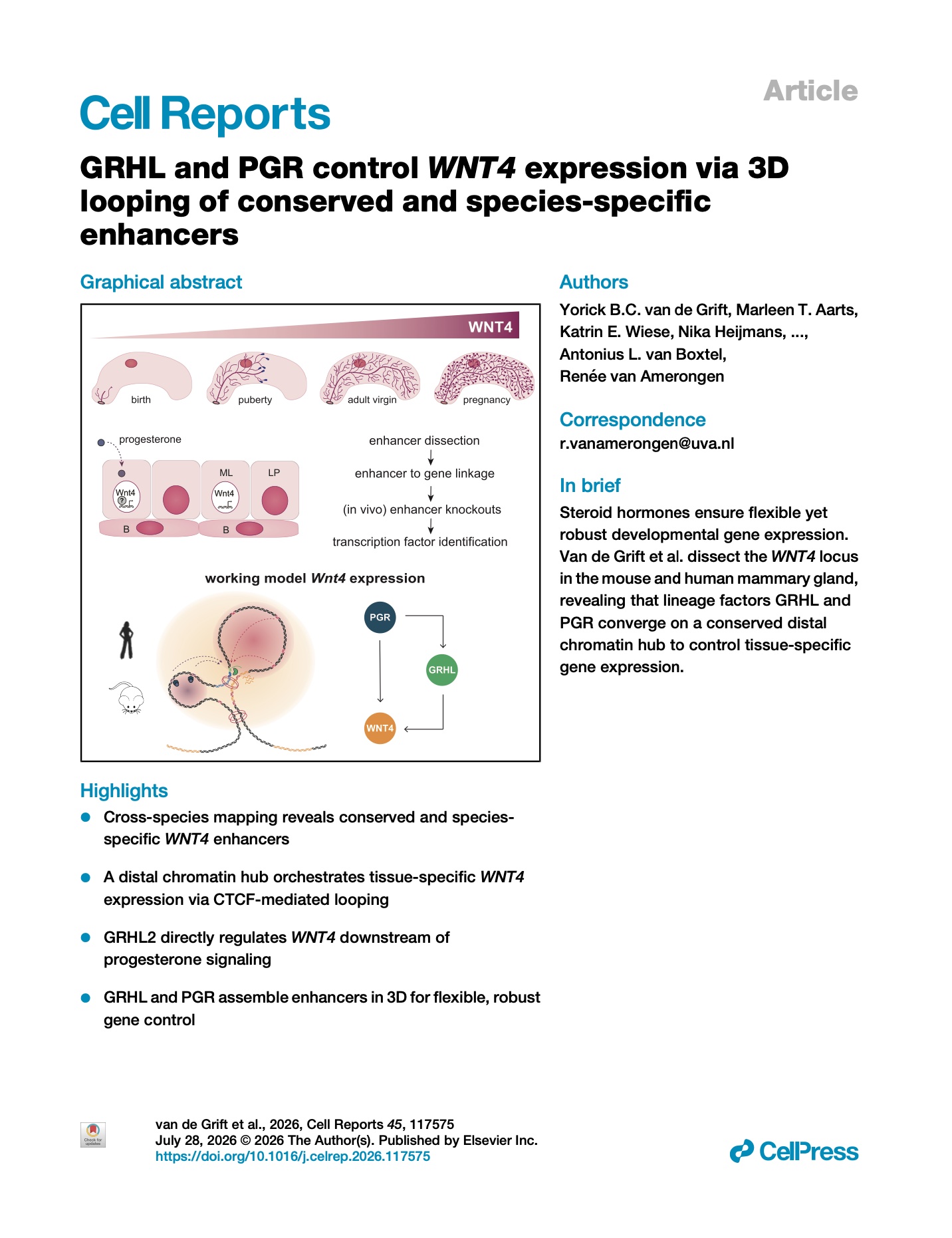
After more than a decade of work, we are happy to report that our manuscript in which we dissect the Wnt4/WNT4 enhancer network in the mouse mammary gland and the human breast, has been accepted for publication (in principle) by Cell Reports.

So, Van de Grift & Aarts & Wiese & Heijmans et al. should soon be available somewhere in its final format. As soon as I get rid of the surplus text that was added to provide the appropriate amount of detail and nuance...

Thanks so much to everyone who was adventurous and tenacious enough to start, continue and finish this journey throughout the years. It is really not sustainable to stretch out a single story across multiple PhD and postdoc projects, but sometimes it really takes that long to understand something. This will forever be colloquially known as our "Cell Paper" (at least it will get the Cell Press layout) and it is one of the most exciting things Renée has been a part of since starting as a scientist.

25 March, 2026


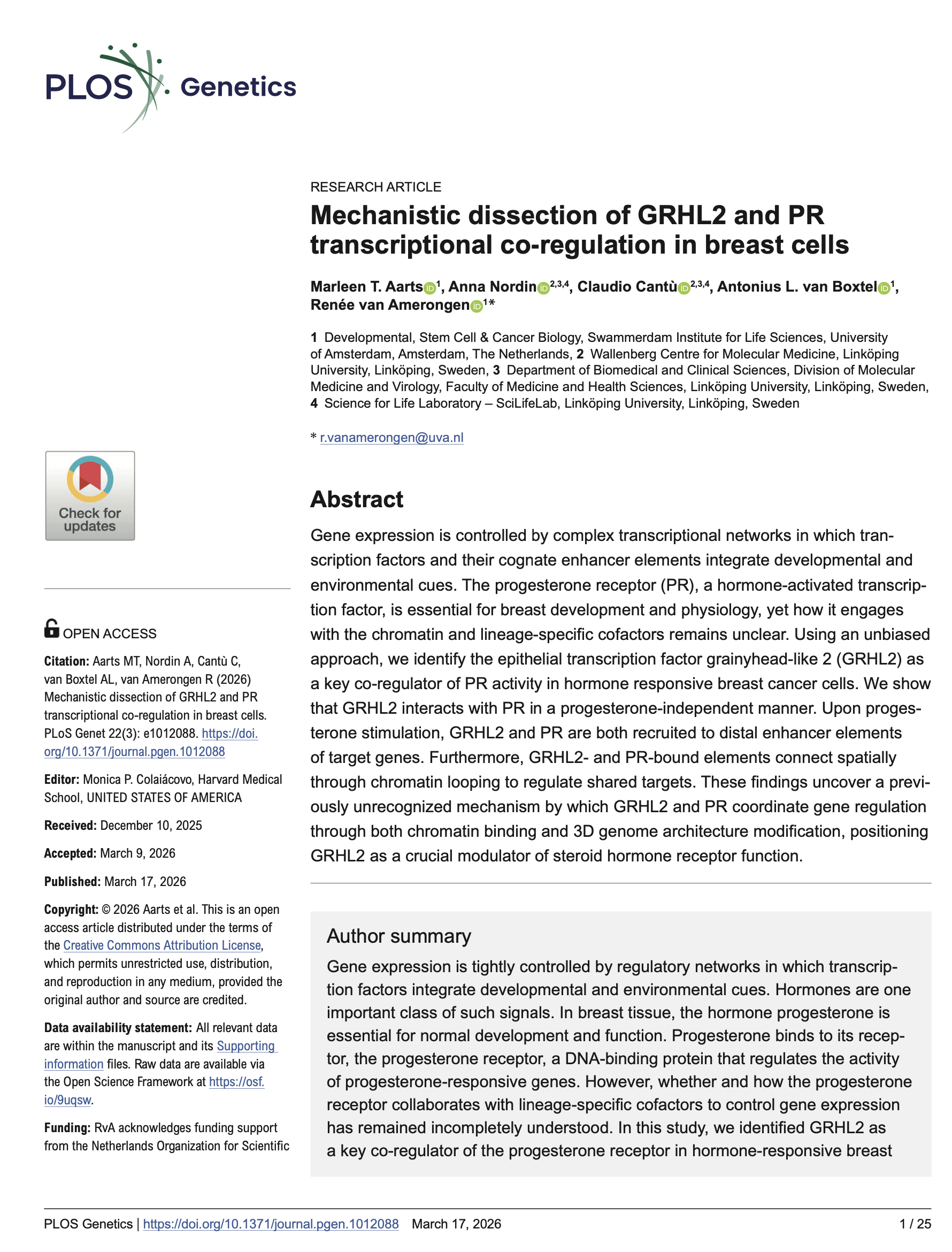
new publication: Mechanistic dissection of GRHL2 and PR transcriptional co-regulation in breast cells

One of Marleen’s PhD thesis chapters has been accepted for publication in PLOS Genetics! It will be out on Monday and is then available by clicking on this link.
Using mass spectrometry to identify the progesterone receptor interactome in breast cancer cells, Aarts et al. identifies the GRHL2 transcription factor as a PGR binding protein, and goes on to investigate if and how PGR and GRHL co-regulate genes in the context of the 3D genome.
This study was the lab’s first use of a mass spectrometry approach - so thank you to Gertjan Kramer and colleagues. It also was our first official collaboration with the lab of Claudio Cantù in Sweden, resulting in our first CUT&RUN datasets! All that and exciting new insights into gene regulation wrapped into one - so check it out!

20 March, 2026


We are hiring: New vacancy for a PhD student to work on KWF project

We are recruiting a PhD student to work on our recently funded KWF research project.
All of the details can be found in the vacancy, which is posted here.

Note that all applications must be submitted through the official vacancy website in order to be processed and considered.

9 March, 2026


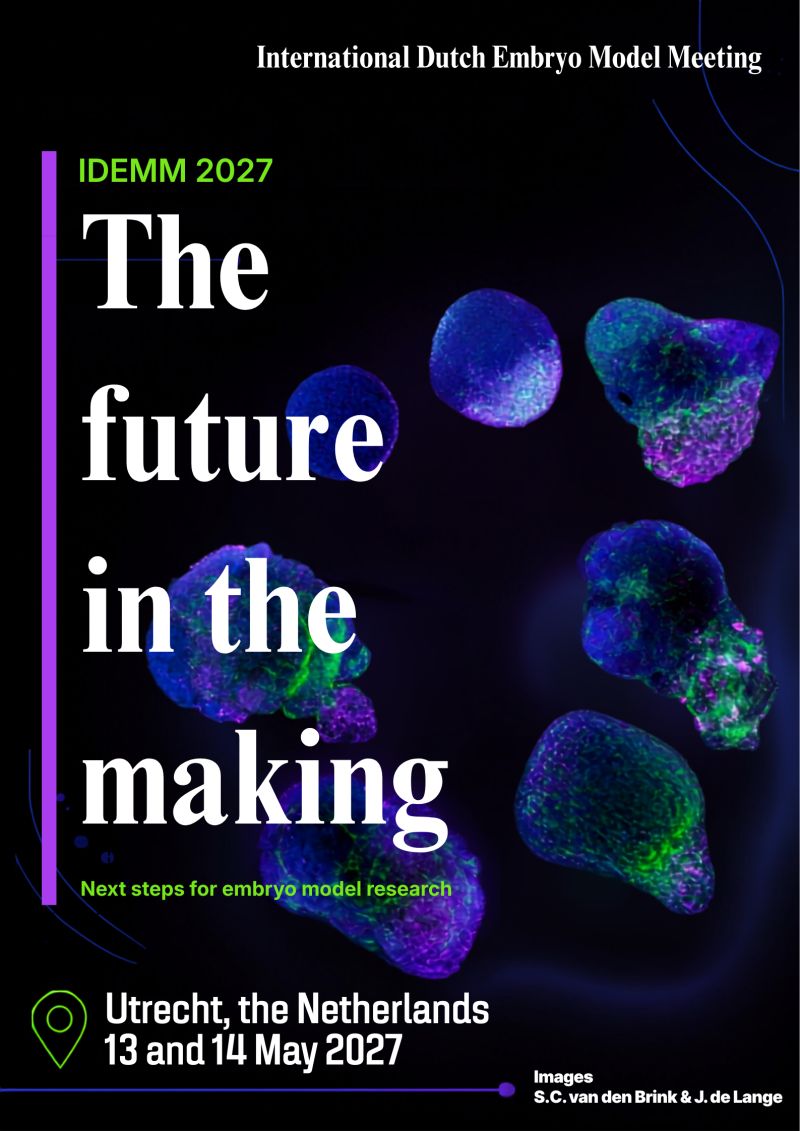
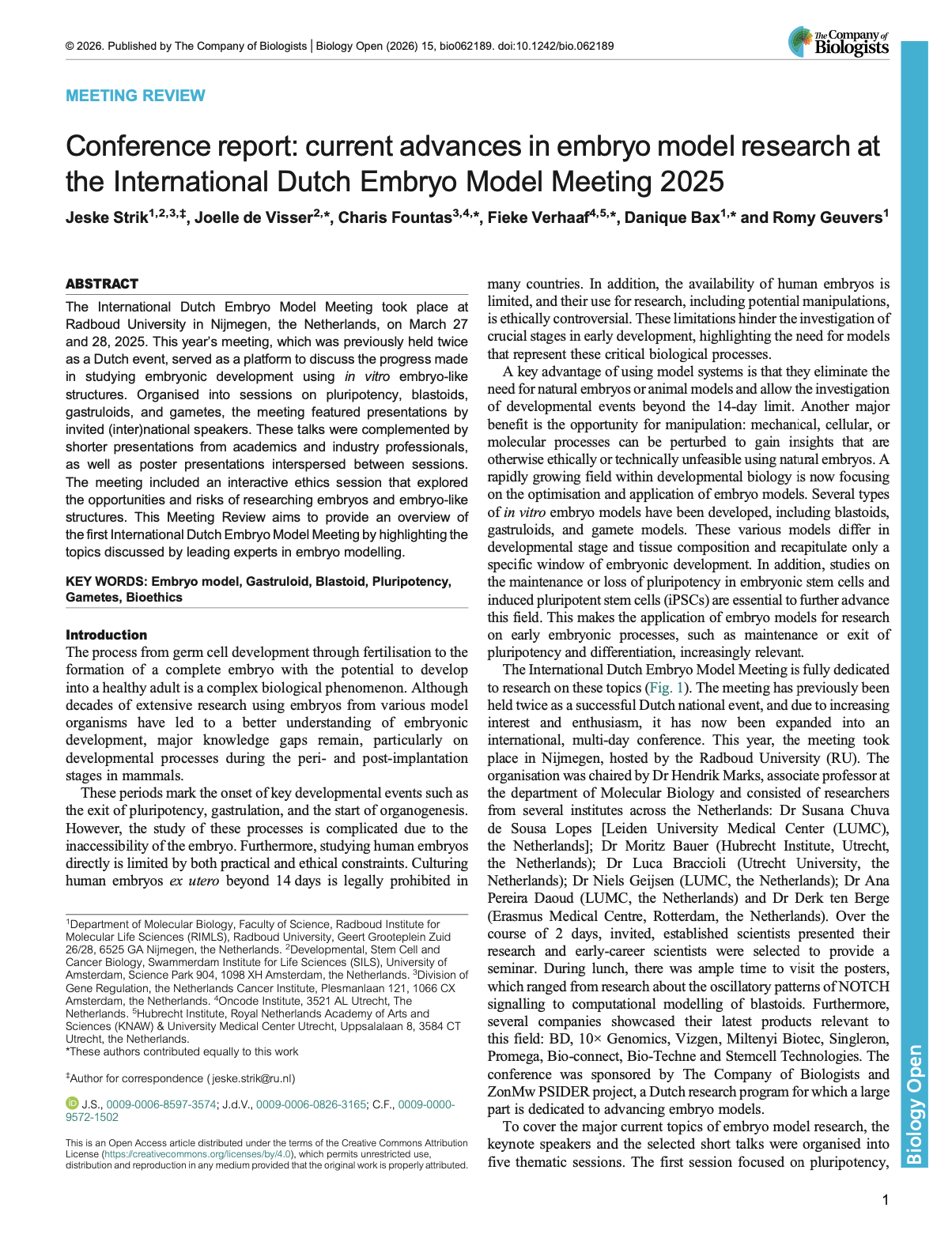
new publication: meeting report of the 2025 International Dutch Embryo Model Meeting

The meeting report of the 2025 International Dutch Embryo Model Meeting is now out and accessible to all in Biology Open via this link. The piece was co-written by all of the NWO-XL PhD students, including Jeske and Joëlle and found a great home with the Company of Biologists, who co-sponsored the event.

30 January, 2026


DSCCB participates in the FNWI DeepTech day 2026

The lab was well represented and actively involved at the first DeepTech day of the Faculty of Science. Meant to showcase our research and innovation across different areas (including the life sciences and biotech), but above all to connect our scientists with policymakers, investors and industry the event was designed to be high energy - and it lived up to its expectation.

Caitrín was the face of our lab at the DSCCB booth, where we showcased our new approach methodologies as "organoids for health innovation". Our pink neon sign shone brightly and our new glossy flyers were hot off the press to launch our "Build the future: Adopt a scientist" campaign.

Thijs pitched our pre-incubation stage valorization efforts towards developing a predictive molecular diagnostic tool for targeting WNT/CTNNB1 signaling in breast cancer in a parallel session on knowledge and technology transfer. First time we presented this work in front of a bigger audience from a valorization perspective, and an excellent way to test the waters and see what questions would be thrown at us. We got useful input that will help us to refine our pitch and business case and also made some exciting connections just in time for our Biotech Booster level 1 application.

Renée chaired the final plenary session of the day. This was an interactive panel discussion around the theme "From Deep Tech Research to Impact", with Constantijn van Oranje (special envoy of TechLeap), Peter Paul Verbeek (rector magnificus at the UvA), Emilia Olsson (group leader at ARCNL) and Renée Frissen (who co-wrote the National AI Deltaplan).

We definitely felt a bit of the Silicon Valley entrepreneurial spirit seep in. We hope it will linger and are inspired to move forward, strengthened by the knowledge that Deep Tech is, by definition, steeped in basic research and lengthy research and development trajectories.

28 January, 2026


Amsterdam UMC Reproduction & Development grant

Together with Callista Mulder (lead applicant), an assistant professor at the Amsterdam UMC whose research focuses on reproductive biology and male infertility, Thijs was awarded an AR&D (Amsterdam Reproduction & Development) research grant. This will enable a new collaboration, in which Thijs and Callista will use the gastruloid model to study primordial germ cell formation. More specifically, this proof-of-principle study will address important gaps in our understanding of how PFAS may disrupt human germline development and pose risks to future generations.

Gastruloids are embryonic stem cell–derived model systems that recapitulate the earliest stages of development, roughly comparable to 2–3 weeks of human gestation. Just as in a real embryo, these gastruloids form and set aside the future germ cells at an early stage. This is where the interests of Thijs and Callista come together: the gastruloid model may provide a means to investigate the earliest developmental origins of human reproductive biology and could even be used to understand how our environment contributes to widespread declining fertility.

The work that is planned has direct relevance for society: A growing concern is exposure to environmental toxins during this early and sensitive stage of development. PFAS, often referred to as a “forever chemical” is a key example. It is highly persistent, poorly degradable, and accumulates in the human body. Worryingly, it was recently discovered that the Dutch population carries high concentrations of PFAS in their blood. In this AR&D-funded project, Thijs and Callista will set out to use human induced pluripotent stem cell (iPSC) derived gastruloids and expose them experimentally during critical windows of germ cell formation. This will allow them to study the effect of PFAS on germline formation and epigenetic reprogramming, an essential process at the start of germ cell formation.

15 January, 2026


KWF grant awarded

We could not have wished for a better Christmas present or way to end the year with a bang: This week we learned that Renée’s grant application "Targeting the WNT/CTNNB1 pathway in breast cancer" was awarded by KWF kankerbestrijding (the Dutch Cancer Society).

This also means that we will be hiring a PhD student and a bioinformatician in the upcoming months!

This project will be a continuation of our last KWF project grant (awarded in 2017), which allowed us to study if and how the WNT pathway is deregulated in human cancer. We are now moving one step further: While there is still a lot of fundamental work to be done, our next grant will also allows us to test if we can now predict which breast cancer patients will respond to a specific WNT pathway intervention.

Thijs and Caitrín are co-PIs on the grant. We are also looking forward to collaborating with other colleagues in the Netherlands and abroad, including Jos Jonkers (NKI).
Exciting times ahead!

We are especially excited that our project was one of 21 research proposals selected to be funded by the proceeds from Alpe d’Huzes.

19 December, 2025


Oratie now also available in PDF and on You Tube

Renée’s oratie is now officially available in written form via UvA DARE via this link. Check it out, because it includes extra bonus material!

The original recording hosted by the UvA will expire after a month, so here is a permanent link to the oratie on You Tube:

6 December, 2025


Oratie Renée

On Thursday 20 November Renée delivered her oratie, or inaugural address "Life, actually: over taaie systemen en bonte details" in the Aula of the Universiteit of Amsterdam.
Thanks to the lab for keeping the show on the road while Renée took some much needed time in the past few weeks to write and tweak the whole thing and thanks to all the guests who came to the ceremony and reception, including a bunch of Biomedical Sciences students.

Those who missed it can still watch it via this link.

And with that, the appointment as Hoogleraar Fundamenteel Stamcel- en Kankeronderzoek (Professor of Stem Cell and Cancer Biology) is officially official. Back to business!

PS: The 45 minute lecture will soon also become available as a PDF and will be published by the UvA university library on UvA DARE. Once it is done, the link will be made available here as well.

20 November, 2025


Joëlle attends workshop by the Company of Biologists

Joëlle was selected to take part in a workshop "New Technologies for Studying and Reprogramming Development", organized by the Company of Biologists and held at Buxted Park in East Sussex, UK. Supported with a travel grant by the Stichting Biochemie, and with an amazing line up of speakers, this was a great opportunity to get input on our own work and to discuss the challenges associated with integrating multi-modal datasets at single-cell resolution.

18 November, 2025


Congratulations dr. Aarts!

On Friday 14 November Marleen defended her PhD thesis "Navigating progesterone-driven gene regulatory networks in the mammary gland" in the Aula of the University of Amsterdam.

Marleen is the sixth PhD student of the lab to defend her thesis, but this is the first time that both the promotor (Renée) and co-promotor (Thijs) came from our own Developmental, Stem Cell and Cancer Biology group. A joyous occasion on may different levels!

Marleen gave a very nice lekenpraatje, comparing gene regulatory networks to switches in a factory and did a very good job during the defense, resulting in a lively discussion with the five opponents.

A special thanks to Dr. Cathrin Brisken to traveling to Amsterdam from Switzerland to join us for the event.


Left: Marleen receives the official diploma from Thijs.
Right: Marleen with proud promotor and co-promotor.

14 November, 2025


Proof of concept grant from IXA awarded

We are excited to report that Renée and Thijs received a Proof of Concept grant from IXA. After lengthy discussions with our technology transfer office and patent lawyers, the award of this grant will help us to try and obtain proof of concept in an effort to strengthen a patent application.

We are one step closer to bringing our findings on WNT signaling in breast cancer from bench to bedside. So far it has been an educational and informative journey and we still have a ways to go (we are already thinking about the next steps) but this is a step in the right direction and a very exciting development for the lab as this is quite a new adventure!

12 November, 2025


PAN podium: Art in the university

At the invitation of the Amsterdams Universiteitsfonds, who previously sponsored our artist in residence program, Renée was invited to take part in a panel discussion at the PAN Art Fair, a large annual art, antiques and design fair at the RAI convention center in Amsterdam. The fair also hosts PAN podium, "a space to be inspired, to connect, to enjoy, and to exchange knowledge" - or, in other words: a forum for discussion of all things art and arts related.

Chaired by Kornelis Fragakis, art curator at TU Delft, Renée joined Babette van den Broek (TU Delft), Jom Luiten (TU Eindhoven) and artist Simone Ho&grava;ng to talk about the collaboration and synergy of art and science.

This was also a nice opportunity to try out the Fishbowl format, which invites members of the public seated in an outer ring to join the inner ring and take active part in the discussion, ensuring that multiple points of view can be heard.

4 November, 2025


Podcast recording

Renée was a guest on an episode of the UvA Podcast "Net Echt" to talk about the new Jurassic World movie. There are worse homework assignments than having to watch a movie in Tuschinski!

This combined everything that Renée holds dear (science, movies and screenwriting), so this was really an exciting opportunity for outreach.

Listen to the episode via Spotify:

17 July, 2025


Berlin Summer School

Rhanna learned essential bioinformatics skills and built a network of expert collaborators by attending the 9th summerschool on NGS data analysis in Berlin, Germany.
Thank you to the Genootschap ter bevordering van Natuur-, Genees- en Heelkunde (GNGH) and the Stichting ter bevordering van het onderzoek in de Biochemie for awarding the travel grants that made this possible!
Time to put these new skills to the test as the data from Rhanna’s first RNAseq experiment should be forthcoming...

5 July, 2025


multi-leg USA visit for the sake of science and our fellow scientists

Renée made her first trip to the United States in quite some time. While she could think of plenty of reasons to not visit as a protest to some of the anti-science developments that are taking place, ultimately she decided that the global geopolitical situation warrants scientists to stick and come together (even if not all scientists are able or feel comfortable to travel/go/work where they would like to at the moment) - and simply to do science in the interest of science and the greater public good. Moreover, there were multiple events scheduled that made the long journey worthwhile as it meant hanging out with friends and colleagues in the WNT signaling community.

First stop: The Gordon Research Conference on WNT signaling in Maine, where she chaired a session and got the opportunity to give a last minute short talk. Still not a big fan of single person plastic dorm pillows and mattresses or shared toilet and shower facilities, but remembering that her old teenage self would have loved this dorm room experience helped. Excellent dining hall at Bates College. though. Who doesn ’t love a soft ice machine.

Second stop: The west coast and Renée’s first return to Stanford since her postdoc days. The occasion was a symposium in honour of Roel Nusse ’s 75th birthday, which Renée helped co-organize. She gave a talk and hosted the Fireside Chat that wrapped up the day. It was lovely to reminisce with former (we should not say old, because they are all aging as if they have spent a lot of time working on a stem cell self renewal factor) lab mates and others that shared a WNT or Nusse connection.

Third stop: San Francisco, for a two-day research visit with Laura van ’t Veer to discuss collaborations on targeting WNT/CTNNB1 signaling in breast cancer. Renée gave a talk for the iSPY executive committee, which was a great opportunity to pitch our work in front of translational scientists involved in one of the biggest clinical trials in the field of breast cancer today. After a second talk at UC Davis (enabled by The Internet in the form of a zoom talk), it was time to wrap up and go home to go back to teaching and grant writing.


From left to right: honorary group picture at the GRC, honorary group picture at the WNT symposium at Stanford, original MSc thesis describing the cloning of human WNT1

4 July, 2025


Jasper gives a talk at the 2025 SILS research day

Jasper got the opportunity to present his work in a talk at the annual SILS research day. Behind the scenes, Rhanna and Joëlle were involved in the organisation as members of the SILS PhD and postdoc council.

28 June, 2025


annual lab BBQ

Thijs kindly hosted the annual lab BBQ again. The weather complied, Jasper took the BSc and MSc students for a short boat ride (and safely returned everyone), the salads and tiramisu were delicious and testified to the excellent practical skills of those involved in their making. Good times were had by all.

2 June, 2025


Cake at De Polder to celebrate publication of our new review article

We had cake in De Polder (again...) to celebrate publication of our review article, Towards an integrated view and understanding of embryonic signalling during murine gastrulation, which is out now in Cells and Development.
The paper is published in part 2 of the Spemann and Mangold centennial special issue, which focuses on self organization in biology. Our review mainly discusses the similarities and differences in developmental signaling via WNT, NODAL, BMP and to a lesser extent FGF between gastruloid models and real embryos. This includes a perspective on how embryo models may be used to advance our understanding of signalling dynamics through computational modeling.

We also ended the day with a social get together, as today was the last official working day of Marleen, who is wrapping up the writing of her PhD thesis and is scheduled to defend in November.


By chance, most of the authors could be captured in a single picture (left), but the whole lab enjoyed cake (right). We learned that our students made the VWO (high school) biology exam (and scored a solid 8), which apparently contained a question about snake venom organoids.

28 May, 2025


25 years of SILS and FNWI

This year officially marks the 25th anniversary of the Science Faculty, as well as of the Swammerdam Institute for Life Sciences. All of the official celebrations coincided in one single week.

On Tuesday, we celebrated the birthday of the faculty (FNWI) and also said our official goodbyes to the current dean, Peter van Tienderen. Together with the departing and very first dean of the faculty, Walter Hoogland, Renée was interviewed by FOLIA. You can watch the video on YouTube.

It was a sunny day, so the celebrations were outside on the last remaining open quadrangle on campus, around the volleyball courts (and the annual volleyball tournament). The Cell and Systems Biology team (with Joëlle, Marleen and Rhanna together with colleagues from our neighboring labs) came in 6th place.


Marleen, Rhanna and Joëlle teamed up with others to form a Cell & Systems Biology theme team.

On Thursday afternoon, we celebrated the 25th anniversary of the Swammerdam Institute. The event was held in De Rode Hoed, a famous location in Amsterdam. It was hosted by philosopher and outsider Bas Haring, which made for some interesting questions and angles. In addition to a panel interview (with representatives of the early and current years, including our former PhD student Anoeska), short videos made by PhD students and postdocs and short talks about some of the societal impact of our work, and woo claps about the future of AI in our research and teaching, we celebrated the official launch of some of the new branding materials for our institute.
Thijs has been actively involved in this project, which included a collaboration with designers from Van Lennep, and prior to the big reveal he gave an introduction on the work of Jan Swammerdam and the excitement about scientific discovery that we still share with him today.


Celebrating the Swammerdam Institute (looks like SILS will only be used for internal and admin purposes from now on) in De Rode Hoed, a beautiful old building on the Keizersgracht, which used to be a church once up on a time, but which is more famous for having hosted a talkshow with Sonja Barend.

23 May, 2025


New publication: Review in Cells and Development

We are excited that our new literature review on gastrulation, gastruloids and computer modelling is out. The study, with Rhanna and Jeske as shared first authors, is part of a special issue of the journal Cells and Development, marking the discovery of the Spemann and Mangold organiser, now over 100 years ago.

In a true team effort, we have brought together a wealth of information on what is known about how embryonic signalling orchestrates the first steps in mouse embryonic development. Although this process has been studied in embryos for many decades, there are still many unanswered questions. Luckily, a relatively new wave of cell culture based models that we also use in the lab, termed gastruloids, is shedding some light on the dynamics and interplay between these signals.


Together with our NWO-XL collaborators Marten Postma and Jeske Strik, we also provide an overview on how computational modelling will be used in the future to study these processes. Ultimately, this kind of work will us help us solve one of the most interesting questions in developmental biology; how a complete organism is formed out of one single fertilised egg.

12 May, 2025


Cake at De Polder to celebrate our new pre-print

It was a sunny day and we had cake outside at De Polder to celebrate our most recent pre-print. We did not think about taking a picture until after the cake was gone, but luckily the pre-print is still there: "GRHL and PGR control WNT4 expression in the mammary gland via 3D looping of conserved and species-specific enhancers".

More good news, as in the morning we also heard that our review on gastruloids was accepted for publication in a special issue of Cells and Development, in honour of the 100th anniversary of the discovery of the Spemann Organizer. More on that later.

29 April, 2025


older news items